
By Vera Gailis
Abstract
This article examines state-produced ID photographs of Yemenite mothers and wives alongside the medical, bureaucratic, and inquiry-related documents that preserved them. The materials derive from case files and inquiry materials related to the Yemenite Children Affair, including documents connected to the Kedmi Commission (Va’adat Kedmi). The Affair concerns the disappearance of infants and young children from immigrant families during the first years of Israeli statehood, and the three state commissions of inquiry that followed. Rather than treating these images as neutral records of identity, the article reads them as fragments of an administrative regime in which migrant motherhood was made legible primarily through numbers, miswritten names, hospital lists, childbirth reports, records of separation, and state investigation. Its central claim is that administrative legibility is not maternal recognition: women could be photographed, registered, numbered, and documented while the mother–child relation itself carried no institutional or evidentiary weight. The archive further demonstrates that maternal agency existed from the outset—mothers searched, nursed, resisted, and demanded information—but operated under conditions of radically unequal institutional traction. The article traces a later shift in which individual maternal search gave way to collective and bureaucratically formatted claims-making—a change in the infrastructure available to maternal knowledge rather than in the presence of maternal agency. The photographs survive by a particular route: families submitted their immigration certificates (Teudot Oleh) to the commissions as evidence, so that a document created to render them legible to the state was later redeployed against it. There is no archival category called “motherhood.” The mothers do not appear because any institution sought to preserve maternal experience; they become retrievable through files organized by the logics of medicine, migration, bureaucracy, family complaint, and official inquiry. Drawing on practice-based artistic research, feminist archival method, and the visual analysis of identification photography, the article asks how Yemenite mothers become legible precisely through histories of loss, separation, reproductive vulnerability, and institutional disregard. It situates this reading alongside a planned installation in which the women’s cropped ID photographs are gathered into a visual encounter, returning the maternal subject to an archive that recorded her without intending to recognize her.
Keywords
Mother Studies; Yemenite Children Affair; maternal recognition; archival photography; migration; feminist archival method
The Face in the File
What does it mean for a mother to be present in the archive when her voice is absent?
The photographs that prompted this question were not gathered through a project designed around Yemenite women. I encountered them while searching the Israel State Archives for images of new immigrants—how they looked, how they were recorded on arrival. The materials belong to case files and inquiry materials related to the Yemenite Children Affair, including documents connected to the Kedmi Commission (Va’adat Kedmi): files concerning missing children, family complaints and statements about disappearances, medical documents on hospitalization, illness, transfer, and in some cases death, and bureaucratic correspondence among hospitals, transit camps, government offices, and health authorities.1
The Affair itself calls for brief description. The Yemenite Children Affair refers to the disappearance of infants and young children from immigrant families—predominantly, though not exclusively, from Yemen—during the first years of Israeli statehood, roughly 1948 to 1954. Children were taken from the transit camps (ma’abarot) and immigrant settlements to hospitals, infant homes, and clinics; parents were subsequently informed that their children had died, in many cases without being given a body, a burial site, or a death certificate. Families have maintained for decades that at least some of the children were removed and given for adoption without parental knowledge or consent. Three state commissions of inquiry—in 1967, in 1988–1994, and in 1995–2001 (the Kedmi Commission)—concluded that the great majority of the children had died, a conclusion that many families, activists, and scholars continue to contest. The scholarship on the Affair is discussed below; what matters for the present argument is the documentary residue those events left behind.
The distinction I draw throughout is between administrative legibility and maternal recognition. Maternal recognition, as I use the term, names an institutional capacity to treat the mother–child relation—and the mother’s knowledge of that relation—as carrying administrative, epistemic, and ethical weight. Identifying a woman as an individual, or recording her as a mother, does not by itself amount to such recognition. A woman may be individually identifiable through a name, number, photograph, or population registry while the maternal relation itself remains institutionally weak, disregarded, or overridden. The archive examined here demonstrates this split with painful precision.
Among these files are immigration certificate documents (Teudot Oleh) belonging to the parents. The Teudat Oleh was the foundational administrative document issued to every new immigrant, establishing legal status and opening access to absorption. The identification photograph affixed to it was the state’s first bureaucratic registration of the immigrant subject. Many of the scanned certificate pages carry two photographs: one of the husband and father, one of the wife and mother. These pages are themselves administrative forms, and like the complaint forms and inquiry tables assembled later, they could record a mother’s name—but neither the name nor any other field protects the relation that disappearance destroys. What is missing is not the word “mother” but an administrative structure capable of treating the maternal relation as central evidence. My attention to this document did not begin in the archive. My practice had for some time worked with Teudot Oleh collected from present-day immigrants; encountering the same form inside the Affair files, I recognized it at once, decades older, which is why the certificate and the face affixed to it became the focus of this work. Searching across these files, I found more than one hundred and fifty fragments containing ID photographs or ID-style images drawn from immigration certificate documentation and related records. The women’s photographs do not appear in every file, but they appear in many of the files I examined.2
These are not photographs created for my project. They are state-produced administrative images, made for identification, migration administration, medical verification, and bureaucratic documentation—never for the preservation of maternal memory. My artistic act is narrow and deliberate: to crop and retrieve the women’s ID photographs from the scanned documents and gather them into a planned installation focused on maternal visibility. The cropping reorients the archive toward the maternal subject it failed to recognize. The father’s photograph remains on the certificate page; what the installation isolates is the face the administrative record registered without recognizing. The article and the installation form a single act of feminist archival attention.
This article extends the foundational distinction between motherhood as institution and mothering as lived experience (Rich 1976) by asking how the maternal subject is regulated and de-authorized within bureaucratic and archival institutions. Motherhood Studies encompasses at least four interconnected areas: motherhood as institution, motherhood as experience, maternal subjectivity, and maternal agency (O’Brien Hallstein, O’Reilly, and Vandenbeld Giles 2020). The present article operates at the intersection of the first, third, and fourth—examining how institutions governed migrant motherhood, how maternal subjectivity was archivally produced and denied, and how maternal agency persisted under acute institutional asymmetry.3
Method
This project proceeds through three intertwined methods: practice-based artistic research, feminist archival reading, and the visual analysis of identification photography. Their combination constitutes the article’s theoretical contribution. Feminist archival reading alone would produce a textual analysis of bureaucratic records. Visual analysis alone would describe the ID photograph as a genre. Practice-based research alone would generate an artistic project. What their intersection produces is a mode of reading in which the form, the photograph, and the artistic act of cropping become a single site of inquiry—one that can show how motherhood was simultaneously recorded and denied within the same administrative gesture. Practice-based research treats the act of cropping, gathering, and exhibiting the photographs as a form of inquiry in its own right: cropping isolates the maternal face from the administrative form that absorbed it, performing analytically the separation the article theorizes. Feminist archival reading approaches state files against their intended grain, asking what they record of maternal lives despite themselves. Visual analysis attends to the ID photograph as a specific genre—frontal, standardized, made for matching a face to a number—and to how such images distribute individuality and anonymity: who is rendered identifiable, and on whose terms. Rich’s distinction between motherhood as lived experience and motherhood as institution underlies the analysis, as does O’Reilly’s matricentric insistence that mothers be treated as subjects of study rather than as secondary figures in family or national narratives.4
A note on corpus and procedure is in order. The archival corpus consists of case files and inquiry materials related to the Yemenite Children Affair held at the Israel State Archives, including documents connected to the Kedmi Commission—the complaint files, medical records, hospital registers, and bureaucratic correspondence described above—much of which became publicly accessible only with the declassification of some 400,000 pages of inquiry materials in December 2016. The photographs were located through an iterative, practice-led archival search. A document or photographic fragment entered the working corpus when it contained an ID photograph or ID-style image of a woman identifiable as a mother or wife within the administrative logic of the file; visual analysis then attended to what the photograph carried beyond its administrative function—the grain, posture, gaze, and framing of a person the form was not designed to preserve. The corpus has clear limitations. It is neither exhaustive nor statistically representative; the women’s photographs do not appear in every file; and precise proportions await full quantification. The reading identifies recurring interpretive patterns across the files examined rather than making prevalence claims about the broader archive; each claim should be understood as arising from the documents examined in this article.
The Politics of Archival Access
These materials are accessible today because of long struggles by Yemenite families and sustained public pressure to investigate the disappearance of children and to open state-held records. The successive commissions of inquiry, culminating in the Kedmi Commission, produced and assembled much of the documentation read here. The files were created by state, medical, and investigative institutions; they were not designed to preserve maternal memory. I enter the archive after this struggle and reread it through the figure of the mother. There is no folder titled “motherhood.” To study maternal life in this archive is to retrieve it from documents organized by the logics of medicine, migration, bureaucracy, complaint, and inquiry.5
It bears emphasizing that the archive holds no systematic visual record of Yemenite mothers or immigrant families. The photographs reach us by a particular route. Families brought their Teudot Oleh to the commissions of inquiry as evidence, since the certificate could prove identity, the fact and date of immigration, residence in the ma’abarot, the composition of a family, and an administrative history. Because the certificates served as evidence in the investigations, they entered the inquiry files; because they entered the files, the identification photographs survived inside the archive that exists today. The bureaucratic document changed hands without changing form. Created to render immigrant families administratively legible to the state, the Teudat Oleh was later preserved and redeployed by those same families as evidence against failures of the administrative system that had produced it. The document’s form remained administrative, but its evidentiary direction reversed: a tool of state legibility became an instrument of familial counter-claim. The photographs persist, then, because mothers and families mobilized bureaucratic documents as evidence in their own struggle for recognition.6
Although these events are remembered as the Yemenite Children Affair, the Kedmi Commission’s mandate concerned the children of immigrants from Yemen, the East, and the Balkans. The conditions through which mothers and children entered the administrative record were general features of the mass immigration of 1948–1953. The Affair remains the focus of this article; it is where these conditions crystallize into the most fully documented case of maternal disregard.
Ariella Azoulay’s account of the civil contract of photography is useful here. A photograph, she argues, is never the sole property of the institution that produced it; it generates an ongoing relation among the photographed person, the photographer, and every later viewer. In the immigration certificates, that contract was left incomplete: the women were photographed to be identified by the state, not to be recognized by it. To gather these images now, and to exhibit them so that viewers must look back, is to attempt a belated honoring of what the archive left undone.7
The Affair and Its Scholarship
The Yemenite Children Affair has been the subject of sustained scholarship, activism, and three state commissions of inquiry. Shoshana Madmoni-Gerber reads the affair through its media framing, showing how the disappearance of Mizrahi—and especially Yemenite—children was minimized, individualized, and explained away, and how that framing reproduced the institutional racism of the early state.8 Ruth Amir places the events within the comparative frame of state-perpetrated forcible child transfers and the politics of historical redress; her later work explicitly names the affair as a site of “shattered motherhoods,” reading the forced separations as gendered and reproductive violence.9 Alongside this work, a literature on state medicine and immigrant absorption supplies the conditions of the affair: Dafna Hirsch has shown how hygiene education addressed to immigrant mothers operated as cultural discipline, while Smadar Sharon and others have traced the technocratic apparatus that processed newcomers through camps and forms.10 Together this scholarship has established the affair’s racialized, political, and biopolitical dimensions.
This article does not claim to offer the first gendered or feminist reading of the Yemenite Children Affair; that ground has been prepared by Amir, Madmoni-Gerber, and others. It contributes, rather, a specific method: a practice-based, visual-archival feminist reading of state-produced ID photographs and bureaucratic forms as evidence of a split between administrative legibility and maternal recognition. The novelty is methodological: the form and the photograph become the very site where motherhood was registered without being recognized.
Administrative Legibility Without Maternal Recognition
A letter of 23 February 1950, from the government hospital in Tzrifin to the Ministry of Health, responds to a newspaper item about “a Yemenite immigrant searching for his lost wife.” The hospital had admitted a sick woman from the Rosh HaAyin transit camp, but recorded her name in a distorted form. She died five days later. Her husband came repeatedly to search for her; staff consulted their lists and told him, each time, that no such patient was there. Only months later, when officials compared the immigration certificate number—certificate no. 183—did they establish that the woman who had died was the wife and mother he had been trying to find through the press.11
The woman was inside the system: admitted, recorded, treated, and, in retrospect, identifiable. Yet the system could not return her to the husband who searched for her. The miswritten name was not a minor clerical error; it became the condition of her disappearance. The certificate, with its photograph, lay somewhere in that archive. She had been seen. She had not been found.
In some documented cases, linguistic and literacy asymmetries entered directly into the production of the record. A 1992 Population Registry investigation notes that when one child was brought to hospital by parents who “did not master the Hebrew language at all,” the child was registered under a distorted name—a distortion that became the basis of a permanent tracking failure.12 A later family appeal states: “My parents did not speak Hebrew, did not know how to read and write, and approached various institutions, but without result.”13 Language and literacy were one dimension of a larger structural asymmetry involving bureaucratic knowledge, mobility, authority, record access, and differential credibility.
Birth Without Witness
A report of 28 February 1950 from the Hashed/Geula transit camp in Aden states that most births occurred in the camp itself without the assistance of a doctor or a nurse. A barrack was later partitioned into sections, and the role of midwife was often filled by a night-duty nurse. What the record preserves of motherhood here is infrastructural insufficiency. Hospitals, transit-camp administrations, and medical systems formed part of a broader governance of migrant motherhood—the regulatory, institutional, and normative apparatus through which mothers were shaped, constrained, and administered (Bromwich 2020; Hughes Miller 2020).14
Adjacent records show mothers as objects of sanitary instruction: in North African transit camps, nurses accompanied mothers to centers where children were weighed and mothers advised on nutrition and cleanliness. Elsewhere, pregnancy appears as a logistical obstacle: correspondence from Casablanca notes that thirteen women beyond the seventh month of pregnancy delayed the departure of seventy-nine people, since shipping companies refused to take them aboard. The pregnant woman enters this correspondence primarily as a logistical impediment to the schedule.15
The files on medical provision record a system of care rationed by timetable and starved of means: physicians were allotted to each camp by schedule—at Magdiel and Tira, a doctor twice a week—so that a woman who went into labor, or a child who fell ill, depended on the day of the week.16 Details of this kind reveal governance operating at the level of scheduling and transport: the institutional apparatus addressed maternity as a logistical variable rather than as a relation it was obliged to protect.
Mothers in the Negative Space
A third archival form consists of handwritten hospital registers headed “Children’s Hospital / List of Yemenite Immigrant Patients.” These pages record children by name, age, diagnosis, and institutional movement; diagnoses such as toxicosis, bronchopneumonia, and dyspepsia recur. Behind every child on the list stands an unnamed mother from whom the child was separated, temporarily or permanently. The mother is present as negative space: the missing relation behind the child’s medical visibility.17
This reading sharpens when the lists are set beside a medical article preserved in the same archive, which discusses the psychological harm caused by the separation of the young child from his mother. The archive thus holds, at once, the practice of separation and the knowledge of its harm. It reveals a contradiction between medical knowledge and administrative practice—between an acknowledged need for maternal presence and the institutional systems that repeatedly displaced it.18
Tina Campt’s work on the quiet registers of vernacular and identificatory photography is instructive here. Photographs made within administrative regimes carry intentions that exceed those regimes; to listen to such images, in Campt’s phrase, is to attend to what they do not say aloud. The ID photograph promises recognition—a face fixed to a name, a number, a file—yet these documents show that identification never guaranteed it.19
Recognition, then, is epistemic as well as relational. The question is whether a mother’s knowledge of her child—her conviction that a death is unverified, her insistence that something is wrong—can enter the institutional record as knowledge, or whether it is translated into grief, irrationality, or administrative inconvenience. When maternal testimony is received as a symptom rather than as evidence, the institution does not merely fail to act; it reverses the direction of credibility.
The erasure traced here had, finally, a symbolic register. At the symbolic edge of the same system, mothers occasionally appear as figures in the official narrative of absorption rather than as subjects within it. As Nitza Berkovitch (1997) has shown, motherhood was elevated as a national mission in the legal and political discourse of early statehood; yet the symbolic centrality of motherhood to the nation did not guarantee recognition of particular maternal subjects. The symbolic mother flourished precisely where the administrative mother went unrecognized—a paradox in which national motherhood and institutional disregard coexisted within the same apparatus.20
The Mechanics of Erasure—and of Maternal Resistance
The preceding sections traced the argument largely through the form of the record. The materials gathered by the commissions of inquiry, however, let the operation be seen at closer range—in the words of the families themselves. Read in sequence, the testimonies disclose a recurring choreography by which the maternal relation was first severed and then unmade as a form of knowledge.
The archive shows maternal action from the outset, exercised under conditions of radically unequal institutional traction. Across the inquiry files, a mother is intensely present to her child—visiting daily, nursing two or three times a day, traveling repeatedly from the ma’abarot to distant hospitals, refusing to let the child be taken alone. In one case, Y. S. walked on foot to the baby home; when nurses refused her entry because the child was asleep, she “entered by force into the room,” only to discover that the child was not there; she then demanded to see the body and was refused.21 A 1963 Ministry of Health letter—a contemporaneous official document, not retrospective testimony—acknowledges: “In fact the parents went from one hospital to another to search for their children, and did not find them.”22 Agency and efficacy must be distinguished. What the archival record shows is a persistent gap between maternal action and institutional consequence—what might be called agency without institutional traction. This distinction resonates with scholarship on the constrained agency of migrant mothers, where strong maternal commitment and knowledge may coexist with sharply limited capacity to convert them into institutional outcomes (Nordberg 2015; Lo 2016).23 It resonates, too, with the broader Motherhood Studies literature connecting maternal activism to interlocking systems of racialized oppression, in which the conditions of claims-making determine what maternal action can accomplish (Shadaan 2020).
The severing began at the most embodied point of the relation. In a letter to the commission of inquiry, M. F. describes the morning after a birth in her family: when the infants were brought to be nursed, her aunt’s child was simply not among them. The mother learned of it from the gap where her child should have been. Nursing, the one relation the body cannot delegate, was also the relation the institution could interrupt without a word.24
What followed was phrased in the neutral vocabulary of care. In testimony before the Kedmi Commission, a separation is narrated as a clinical routine: the child was unwell, and so she had to be taken for treatment. The formula performs the removal: “treatment” supplies at once the justification and the mechanism, converting a unilateral taking into a medical procedure and leaving the mother no standing from which to refuse, accompany, or follow.25
When children were pronounced dead, the record that should have fixed the fact was itself careless. A report by the commission’s investigators notes that a recorded burial date, 21 March 1950, was “fundamentally mistaken,” since the burial in fact carried the date 23 January 1950. Contradictory dates, mismatched institutions, and incompatible documents accumulate around a single child. The apparatus that had been exact in registering mothers as data was negligent in accounting for their children’s fates.26
Death, once declared, was not made tangible. Among the questions the families pressed upon the commissions stands a single line: why were the children’s bodies not shown to their parents? With no body there could be no burial witnessed, no mourning completed, no end conceded. For many families the condition was not bereavement but what Pauline Boss has termed “ambiguous loss”—loss without verification, sustained by contradictory records, unresolved across decades. This is also an object of concern within Motherhood Studies: scholarship on maternal grief emphasizes that maternal identity persists beyond loss, and that the social validation or invalidation of that continuing identity profoundly shapes the conditions under which a mother can mourn (Davidson and Stahls 2010).27
And where a mother refused the official account, her refusal was reclassified as pathology. A nurse’s testimony preserves an exchange from 1950: asked why “this Yemenite woman” sat weeping every day, the physician answered that “she does not believe that her daughter is dead.” The mother’s knowledge—her conviction that something was wrong—is here neither investigated nor believed but diagnosed, folded back into the figure of the irrational, distrustful immigrant woman. This is the exact inverse of recognition: maternal testimony received as a symptom.28
In the investigators’ own working forms the mother appears as a standardized field—mother’s name—ranged beside the father’s name, the year of immigration, and the identity numbers. The document can hold her name without holding her loss.29
From Maternal Search to Institutional Claim
The archival record reveals a transition from individual, embodied maternal resistance to collective, mediated, institutionally legible claims-making. The early maternal actions documented above—walking to hospitals, demanding bodies, rejecting unverified declarations of death—did not disappear; rather, the infrastructure through which such actions could become consequential changed. In 1966, several families received military draft notices for children who had been declared dead years earlier. The notices exposed an administrative afterlife: a child whose disappearance or death the family had been expected to accept remained administratively alive elsewhere in the state system. The same apparatus that had failed to provide families with verifiable knowledge of a child’s fate could later address that child as a living administrative subject.30 A 1992 Population Registry investigation confirmed, in at least one case, that the child’s death had never been entered into the computerized population database—providing a plausible administrative mechanism, though one that should not be generalized beyond the documented case.31
The commission’s retrospective account, consistent with Menashe Anzi’s reconstruction of the first organized wave of protest, notes that younger members of the community initiated the establishment of a public committee.32 Some case files reveal intergenerational mediation: E. Y., then an adolescent sibling, preserved the draft notices among her documents for decades before submitting them to the Kedmi Commission. By the 1980s, standardized case registry forms—“Name of Child,” “Place of Disappearance,” “Name of Mother”—show that family claims had themselves become bureaucratically formatted.33 The shift was not that mothers acquired agency; it was that maternal and familial claims acquired a new institutional infrastructure.
The Photograph and the Encounter
The archival reading traced above arrives at a limit: the article can demonstrate the split between registration and recognition, but it cannot undo it. The installation developed alongside this article attempts what textual analysis alone cannot—a return of the maternal face to the field of encounter. The cropped ID photographs of Yemenite women, retrieved from the immigration certificate pages and related documents within the inquiry materials, are to be gathered as portraits and presented at a scale and in a configuration that obliges the viewer to look directly at each woman (see Figure 1). The administrative logic that produced these images—rendering a person identifiable—is interrupted by a logic of encounter.
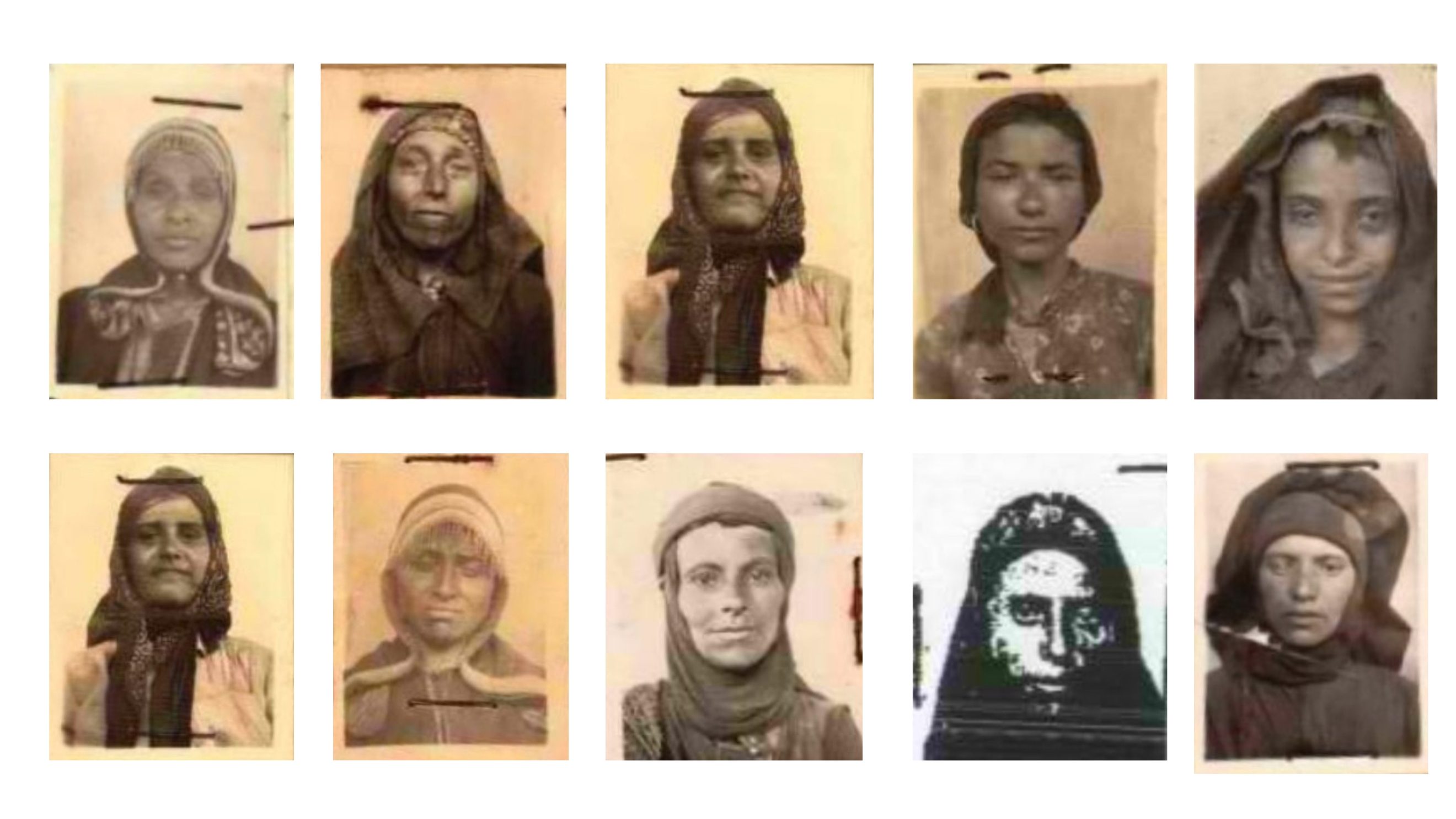
The women in these photographs are no longer alive. In many families, the photographs themselves have not survived—documents were lost in transit, in moves between camps and towns, in the decades that followed. The state archive, which never intended to preserve these women as maternal subjects, is now in many cases the only institution that holds their faces. And these are faces at the moment of loss: the identification photograph was made upon immigration, during the same period in which the children disappeared. The woman in the image is not remembering; she is the young mother at the point where the archive and the separation coincide. The apparatus that failed to recognize the mother–child relation has become the last custodian of the mother’s image—an image fixed at the very age of her bereavement. This is what gives the installation its necessity: the retrieval of faces that may exist nowhere else.
The ethics of exhibiting these photographs begins from this tension. I do not approach the images as neutral archival material available for artistic use simply because they have entered a public record. The archival files discussed here are publicly accessible, and their opening was itself the result of sustained family activism: in December 2016 the State of Israel declassified some 400,000 pages of inquiry materials. The affected families and activists fought for decades for these records and histories to be made public. This context matters: the families themselves sought disclosure, not concealment. At the same time, public accessibility does not automatically resolve all ethical questions concerning reproduction, exhibition, and recontextualization.34
Although I retain the historical specificity of individual cases, I use initials for individual mothers, children, and relatives discussed through particular case files. This is an editorial choice that preserves the historical visibility of the cases while avoiding full-name identification where it adds no analytical value; the archive itself imposes no requirement of anonymity. This decision is distinct from visual anonymization: the planned installation deliberately returns attention to the faces preserved inside administrative files, because visibility is historically and politically meaningful.
My own position is situated: I come to these materials as an immigrant artist-researcher working through visual archives and histories of migration and classification. The project is informed by conversations with representatives of families connected to the Affair, for whom the visibility of names and faces remains ethically important, and by the ethical framework of radical empathy articulated by Caswell and Cifor, which emphasizes relational responsibility toward record subjects and descendants. The impossibility of obtaining individual consent from every person represented in decades-old state files is intrinsic to archival research on this scale and is not resolved by the files’ public status.35
The method developed here is closer to excavation than to fabulation: it finds what is already present in the documents and photographs, and insists that it be seen.36
Conclusion
There is no archival category called “motherhood.” These women survive in the record because files organized by medicine, migration, bureaucracy, and inquiry happened to retain their faces and names. What remains unprotected is the maternal relation itself—the tie between mother and child that, as Yuval-Davis’s work on gender and nation would predict, should have structured registration, transfer, care, and return but was instead subsumed into the state’s broader demographic project.
The article has traced three interconnected conditions. First, administrative legibility without relational recognition: the state’s documentary apparatus could identify, register, photograph, and file a woman as an individual while the mother–child relation carried no protected institutional or evidentiary weight. Second, maternal agency under unequal conditions of institutional traction: the archival record shows women who searched, nursed, resisted, demanded information, and rejected unverified accounts—actions whose institutional efficacy was sharply constrained by linguistic, bureaucratic, and political asymmetries. Third, the later transformation of individual family knowledge into collectively and bureaucratically legible claims: through preserved documents, younger intermediaries, public committees, and formal inquiry, the conditions of claims-making changed, and maternal and familial knowledge could increasingly enter the institutional record as evidence rather than as pathology or inconvenience.
The task of the artist-researcher is to reorient the archive toward the maternal subjects it recorded without intending to recognize—a reorientation that claims no ownership over these archival lives. Feminist archival retrieval does not “give” these women agency they lacked. Their agency existed. What retrieval makes possible is the legibility of historically constrained maternal action—and an encounter with the faces the archive preserved while failing to preserve the relations those faces carried.
Footnotes
- On the epistemics of state and colonial record-keeping, see Ann Laura Stoler, Along the Archival Grain (Princeton: Princeton University Press, 2009). On feminist attention as a mode of care and interruption, see Lisa Baraitser, Maternal Encounters: The Ethics of Interruption (London: Routledge, 2009). ↩︎
- The women’s photographs do not survive in every file; they are present in many of the files examined. Precise proportions await full quantification. A representative example is an immigration certificate (Teudat Oleh) stamped 2 August 1949 and bearing certificate nos. 17825 and 56991 (Israel State Archives, Kedmi Commission files). ↩︎
- Adrienne Rich, Of Woman Born: Motherhood as Experience and Institution (New York: W. W. Norton, 1976); Andrea O’Reilly, Matricentric Feminism: Theory, Activism, and Practice (Bradford: Demeter Press, 2016); Lynn O’Brien Hallstein, Andrea O’Reilly, and Melinda Vandenbeld Giles, eds., The Routledge Companion to Motherhood (Abingdon: Routledge, 2020), Introduction, 1–15. ↩︎
- Rich, Of Woman Born; O’Reilly, Matricentric Feminism. ↩︎
- Stoler, Along the Archival Grain. ↩︎
- Ariella Azoulay, The Civil Contract of Photography (New York: Zone Books, 2008); on the lasting relation a photograph institutes among subject, photographer, and viewer, see Azoulay, 85–135. On radical empathy and relational responsibility in archival practice, see Michelle Caswell and Marika Cifor, “From Human Rights to Feminist Ethics: Radical Empathy in the Archives,” Archivaria 81 (Spring 2016): 23–43. ↩︎
- Azoulay, Civil Contract. ↩︎
- Shoshana Madmoni-Gerber, Israeli Media and the Framing of Internal Conflict: The Yemenite Babies Affair (New York: Palgrave Macmillan, 2009). Madmoni-Gerber’s recent work reads the affair through an intersectional feminist lens: Shoshana Madmoni-Gerber, “‘Maybe We Did Them a Favor’: Reading the Yemenite Babies Affair Through an Intersectional Feminist Lens,” Palestine/Israel Review 4, no. 1 (2026). DOI: 10.5325/pir.4.1.0001. ↩︎
- Ruth Amir, Twentieth Century Forcible Child Transfers (Lanham, MD: Lexington Books, 2018). Ruth Amir, “The Yemeni, Mizrahi, and Balkan Children Affair: Lost Infants, Shattered Motherhoods,” Women in Judaism: A Multidisciplinary e-Journal 17, no. 2 (2021). DOI: 10.33137/wij.v17i2.36890. ↩︎
- On hygiene education, see Dafna Hirsch, “‘We Are Here to Bring the West,’” International Journal of Middle East Studies 41, no. 4 (2009): 577–594. On immigrant absorption, see Smadar Sharon, “The Dialectic between Modernization and Orientalization,” Ethnic and Racial Studies 40, no. 4 (2017): 732–750. ↩︎
- Original Hebrew: עולה מתימן המחפש את אשתו האבודה (“a Yemenite immigrant searching for his lost wife”; translation mine). Letter from the Director of the Government Hospital, Tzrifin, to the Ministry of Health, 23 February 1950, responding to an item in Maariv, 17 February 1950. Israel State Archives, file 1/149/7 (stamp 50/1248). ↩︎
- R. Bardugo, Advisor to the Director of the Population Registry, investigation report to Dr. M. Shalgi, 20 January 1992. Israel State Archives, file 109/ב, case חיים אבודרה (501/ל); translation mine. Hebrew original: שלא שלטו בשפה העברית ובכלל. ↩︎
- Written family appeal of Simcha and Shmuel Chaim Sa’idi to Justice Yaakov Kedmi, received 23 December 1999. Israel State Archives; translation mine. Hebrew original: הורי לא דוברי עברית, לא ידעו קרוא וכתוב, פנו למוסדות השונים אך ללא הועיל. ↩︎
- On the governance of mothers through formal state mechanisms, regulations, public policy, and institutional expertise, see Rebecca Jaremko Bromwich, “Formal Governance of and by Mothers,” and Michelle Hughes Miller, “The Governance of Mothers,” both in O’Brien Hallstein, O’Reilly, and Vandenbeld Giles, Routledge Companion to Motherhood (2020). Report from the Hashed/Geula transit camp, Aden, 28 February 1950. Israel State Archives, file 1/149/7. ↩︎
- Casablanca correspondence: letter from Dr. E. Mattan to Dr. A. Gonick, A.J.D.C. European headquarters, Paris, 5 January 1955; figures of thirteen and seventy-nine confirmed in source. Israel State Archives, folder marks 1/5/4 and 6/149/7. ↩︎
- Chief Manpower Inspector to Traffic Inspector, 8 November 1951; Dr. T. Yeshurun-Berman to Ministry of Health, early 1950s. Israel State Archives, file “Doctors for the Ma’abarot” (רופאים למעברות); translations mine. ↩︎
- Original Hebrew: בית חולים לילדות וילדים / רשימת חולים עולי תימן. Handwritten hospital registers, Tzrifin, March 1950, filed with cover letters stamped 501/1969 and 146/7 (Israel State Archives). ↩︎
- J. A. Gillet, “Domiciliary Treatment of Sick Children” (Medical Officer of Health, County Borough of Rotherham), reprinted and circulated internally within the Ministry of Health, March 1954; Israel State Archives, file 38/14/241. ↩︎
- Tina M. Campt, Listening to Images (Durham: Duke University Press, 2017). On photography, kinship, and inherited memory, see Marianne Hirsch, Family Frames (Cambridge, MA: Harvard University Press, 1997). ↩︎
- Nitza Berkovitch, “Motherhood as a National Mission: The Construction of Womanhood in the Legal Discourse in Israel,” Women’s Studies International Forum 20, nos. 5/6 (1997): 605–619. An album of children presented to David Ben-Gurion, in which the word “mothers” (אמהות) appears within the official language of absorption. Israel State Archives; n.d. ↩︎
- Handwritten statement of Y. S. submitted to the Public Committee, 9 November 1985. Israel State Archives, file ג/49, 313/ג; translation mine. The witness statement of Y. S. (typed, with official stamp of the State Inquiry Commission), 11 February 1996, Israel State Archives, file ג/49, 182/נ, confirms the account and adds that draft notices and a hospitalization payment demand were later received in the missing child’s name. Hebrew original: נכנסתי בכוח לתוך החדר. ↩︎
- M. Sha’al, Director of the Hospital Department, Ministry of Health, to the General Inspector and Head of Investigations, Israel Police, 16 February 1963. Israel State Archives, file 2/10/12773; translation mine. This is contemporaneous official correspondence, not retrospective testimony. Hebrew original: למעשה ההורים הלכו מבית חולים אחד לשני כדי לחפש את הילדים שלהם, ולא מצאו אותם. ↩︎
- On constrained agency among migrant mothers, see Camilla Nordberg, “Invisibilised Visions: Migrant Mothers and the Reordering of Citizenship in a Nordic Welfare State Context,” Nordic Journal of Migration Research 5, no. 2 (2015): 67–74; on motherhood capital and institutional negotiation, see Ming-Cheng M. Lo, “Cultural Capital, Motherhood Capital, and Low-Income Immigrant Mothers’ Institutional Negotiations,” Sociological Perspectives 59, no. 3 (2016): 694–713. These sources name the mechanism without implying equivalence with 1950s Israel. On maternal activism and interlocking oppressions, see Reena Shadaan, “Mothering and Activism,” in Routledge Companion to Motherhood (2020), 486–495. ↩︎
- Letter of M. F. to the commission of inquiry, received by the Ministry of Justice, 29 December 1999 (Israel State Archives); translation mine. The term used in the letter for nursing is להנקה. ↩︎
- Testimony before the Kedmi Commission, transcript p. 4884; Israel State Archives, file 9747/1-ג (גל 15/1); translation mine. The word used in the testimony is לטיפול. ↩︎
- Report of the commission investigators, 12 December 1993, case no. 1147/ל; Israel State Archives, file 9802/12-ג (48/12); translation mine. ↩︎
- Pauline Boss, Ambiguous Loss: Learning to Live with Unresolved Grief (Cambridge, MA: Harvard University Press, 1999). On maternal grief within Motherhood Studies, see Deborah Davidson and Helena Stahls, “Maternal Grief: Creating an Environment for Dialogue,” Journal of the Motherhood Initiative for Research and Community Involvement 1, no. 2 (2010): 16–25. I use “ambiguous loss” to describe the structural condition of loss without verification, not to impose a retrospective psychological diagnosis on the historical subjects. List of questions submitted to the commissions of inquiry, p. 4; Israel State Archives, file 9803/8-ג (49/8); translation mine. Hebrew original: מדוע לא הראו גופות הילדים להוריהם? ↩︎
- Testimony of a nurse concerning events of 1950, p. 3; Israel State Archives, file 9803/8-ג (49/8); translation mine. Hebrew original: היא אינה מאמינה שבתה מתה. ↩︎
- Working forms of the investigator D. Liton, bearing Ministry of the Interior (Population and Immigration) stamps, form nos. 233/ג, 227/ג, 16/ג, 191/ג, 89/ג (Israel State Archives). The form field reads שם האם (mother’s name). ↩︎
- MK Ra’anan Cohen, Knesset plenary, 23 May 1994 (retrospective parliamentary testimony about 1966 events), Israel State Archives, Knesset protocol, p. 2. E. Y., testimony before the Kedmi Commission, 1 January 1996, transcript p. 4887 (firsthand oral testimony recalled from adolescence). Y. S. (mother), typed witness statement, 11 February 1996, Israel State Archives, file ג/49, 182/נ, confirms receipt of draft notices and a hospitalization payment demand. Translations mine. ↩︎
- R. Bardugo, Population Registry investigation report, 20 January 1992 (Israel State Archives, file 109/ב, case 501/ל): “His death was not recorded in the computerized database of the population registry” (פטירתו לא נקלטה בקובץ הממוכן של מרשם האוכלוסין). This finding provides a plausible administrative mechanism for the generation of draft notices for persons known elsewhere to have died; it should not be generalized beyond the documented case. ↩︎
- Commission report, historical chapter, p. 22 (Israel State Archives); see also Menashe Anzi, “‘If I Am a Brother, Where Is My Sister?,’” in Children of the Heart, ed. Gamliel and Shifriss (Tel Aviv: Resling, 2019), 401–431. Translations mine. ↩︎
- Standardized case registry forms, Public Committee for Finding the Missing Yemenite Children, c. mid-1980s. Israel State Archives, case nos. 78, 108, 217; hand-stamped הוועדה לגילוי ילדי עולי תימן הנעדרים. E. Y.’s preservation of the draft notices among her own documents is attested in her testimony, transcript p. 4887. ↩︎
- On the struggle for disclosure and the 2016 declassification, see the “I Ask for My Brothers” database (Israel State Archives). The Amram association, which documents cases and campaigned to open the files, has insisted that recognition of the wrong cannot depend on what the official archive does or does not contain. ↩︎
- On situated knowledge, see Donna Haraway, “Situated Knowledges,” Feminist Studies 14, no. 3 (1988): 575–599. On the face as ethical claim, see Judith Butler, Precarious Life (2004). Caswell and Cifor, “From Human Rights to Feminist Ethics.” ↩︎
- Saidiya Hartman, “Venus in Two Acts,” Small Axe 12, no. 2 (2008): 1–14. Stoler, Along the Archival Grain. ↩︎
Bibliography
Amir, Ruth. Twentieth Century Forcible Child Transfers: Probing the Boundaries of the Genocide Convention. Lanham, MD: Lexington Books, 2018.
Amir, Ruth. “The Yemeni, Mizrahi, and Balkan Children Affair: Lost Infants, Shattered Motherhoods.” Women in Judaism: A Multidisciplinary e-Journal 17, no. 2 (2021). DOI: 10.33137/wij.v17i2.36890.
Anzi, Menashe. “‘If I Am a Brother, Where Is My Sister?’: On the First Wave of Protest Led by ‘The Public Committee for Finding the Missing Yemenite Children’ and the Newspaper ‘Afikim’” [Hebrew]. In Children of the Heart: New Aspects of Research on the Yemenite Children Affair, edited by Tova Gamliel and Nathan Shifriss, 401–431. Tel Aviv: Resling, 2019.
Azoulay, Ariella. The Civil Contract of Photography. New York: Zone Books, 2008.
Baraitser, Lisa. Maternal Encounters: The Ethics of Interruption. London: Routledge, 2009.
Berkovitch, Nitza. “Motherhood as a National Mission: The Construction of Womanhood in the Legal Discourse in Israel.” Women’s Studies International Forum 20, nos. 5/6 (1997): 605–619.
Boss, Pauline. Ambiguous Loss: Learning to Live with Unresolved Grief. Cambridge, MA: Harvard University Press, 1999.
Bromwich, Rebecca Jaremko. “Formal Governance of and by Mothers: Mothers, Public Policy, and Law.” In The Routledge Companion to Motherhood, edited by Lynn O’Brien Hallstein, Andrea O’Reilly, and Melinda Vandenbeld Giles, 429–441. Abingdon: Routledge, 2020.
Butler, Judith. Precarious Life: The Powers of Mourning and Violence. London: Verso, 2004.
Campt, Tina M. Listening to Images. Durham: Duke University Press, 2017.
Caswell, Michelle, and Marika Cifor. “From Human Rights to Feminist Ethics: Radical Empathy in the Archives.” Archivaria 81 (Spring 2016): 23–43. DOI: 10.21083/archivaria.v81i0.13557.
Davidson, Deborah, and Helena Stahls. “Maternal Grief: Creating an Environment for Dialogue.” Journal of the Motherhood Initiative for Research and Community Involvement 1, no. 2 (2010): 16–25.
Haraway, Donna. “Situated Knowledges: The Science Question in Feminism and the Privilege of Partial Perspective.” Feminist Studies 14, no. 3 (1988): 575–599.
Hartman, Saidiya. “Venus in Two Acts.” Small Axe 12, no. 2 (2008): 1–14.
Hirsch, Dafna. “‘We Are Here to Bring the West, Not Only to Ourselves’: Zionist Occidentalism and the Discourse of Hygiene in Mandate Palestine.” International Journal of Middle East Studies 41, no. 4 (2009): 577–594.
Hirsch, Marianne. Family Frames: Photography, Narrative, and Postmemory. Cambridge, MA: Harvard University Press, 1997.
Hughes Miller, Michelle. “The Governance of Mothers.” In The Routledge Companion to Motherhood, edited by Lynn O’Brien
Hallstein, Andrea O’Reilly, and Melinda Vandenbeld Giles, 462–474. Abingdon: Routledge, 2020.
Lo, Ming-Cheng M. “Cultural Capital, Motherhood Capital, and Low-Income Immigrant Mothers’ Institutional Negotiations.” Sociological Perspectives 59, no. 3 (2016): 694–713.
Madmoni-Gerber, Shoshana. Israeli Media and the Framing of Internal Conflict: The Yemenite Babies Affair. New York: Palgrave Macmillan, 2009.
Madmoni-Gerber, Shoshana. “‘Maybe We Did Them a Favor’: Reading the Yemenite Babies Affair Through an Intersectional Feminist Lens.” Palestine/Israel Review 4, no. 1 (2026). DOI: 10.5325/pir.4.1.0001.
Nordberg, Camilla. “Invisibilised Visions: Migrant Mothers and the Reordering of Citizenship in a Nordic Welfare State Context.” Nordic Journal of Migration Research 5, no. 2 (2015): 67–74.
O’Brien Hallstein, Lynn, Andrea O’Reilly, and Melinda Vandenbeld Giles, eds. The Routledge Companion to Motherhood. Abingdon: Routledge, 2020.
O’Reilly, Andrea. Matricentric Feminism: Theory, Activism, and Practice. Bradford: Demeter Press, 2016.
Rich, Adrienne. Of Woman Born: Motherhood as Experience and Institution. New York: W. W. Norton, 1976.
Shadaan, Reena. “Mothering and Activism.” In The Routledge Companion to Motherhood, edited by Lynn O’Brien Hallstein, Andrea O’Reilly, and Melinda Vandenbeld Giles, 486–495. Abingdon: Routledge, 2020.
Sharon, Smadar. “The Dialectic between Modernization and Orientalization: Ethnicity and Work Relations in the 1950s Lakhish Region Project.” Ethnic and Racial Studies 40, no. 4 (2017): 732–750.
Shvarts, Shifra, Nadav Davidovitch, Rhona Seidelman, and Avishay Goldberg. “Medical Selection and the Debate over Mass Immigration in the New State of Israel (1948–1951).” Canadian Bulletin of Medical History 22, no. 1 (2005): 5–34.
Stoler, Ann Laura. Along the Archival Grain: Epistemic Anxieties and Colonial Common Sense. Princeton: Princeton University Press, 2009.
Yuval-Davis, Nira. Gender and Nation. London: SAGE, 1997.


