“One need not be a chamber to be haunted,
One need not be a house;
The brain has corridors surpassing
Material place.”
— Emily Dickinson
Dreams for Daughters: Intergenerational Symbols of Longing, House, and Home
I. The Mother has always dreamed of houses and often tells her daughter each dream. The Mother’s dreams would seem at times to echo or seep into daughter’s dreams. The Mother dreams of broken rural houses in which she grew up, with shattered glass and stairways, coldness and deprivations, a lack of running water, in an unincorporated township with its elementary school that no longer exists. Those past houses are both haunted and haunting. Yet some homes had fresh eggs, tiny homegrown strawberries, rich cream atop milk, and were the sites of her ravenous hunger for books the Mother found – books that saved her when she dropped out of school. She reads her daughter the same yellowed stories and poetry, feeding her line by line like threads of honey on a silver spoon at bedtime.
And yet the Mother’s angry relatives’ shadows seem to loom large in darkened doorways of the past at night. Just one relative visited once, briefly – and the daughter cannot tell if it was a dream that a brooding, broken silhouette actually appeared at the kitchen table one night when she was supposed to be asleep.
The daughter doesn’t remember much of her father’s presence at home either. One night when her Mother was working and for reasons she cannot recall, she asked her father about his favorite books and if he believed in ghosts, and he quietly said yes. She found herself searching the shadowy periphery of her vision in every house ever since.
Like hungry and angry ghosts, some nightmares of the Mother come true, hauntings threatening the home itself. A termite infestation infects the Mother’s dreams as well as the home in which the daughter was born. There is a whirring sound of the Mother constantly vacuuming the foundation-devouring creatures in the basement while the daughter holds her baby sister (who holds a matching doll that looks just like a twin).
They flee and go house hunting, naming the prospective homes with a sort of elemental shorthand: the airy “cliff house,” the glittering “geode house,” the mildewy “leaky basement house,” a fiery “red house.” The Mother settles on the jewel-like “pool house,” enclosed in rows of tall evergreens (a home which will take her thirty years of mortgage payments).
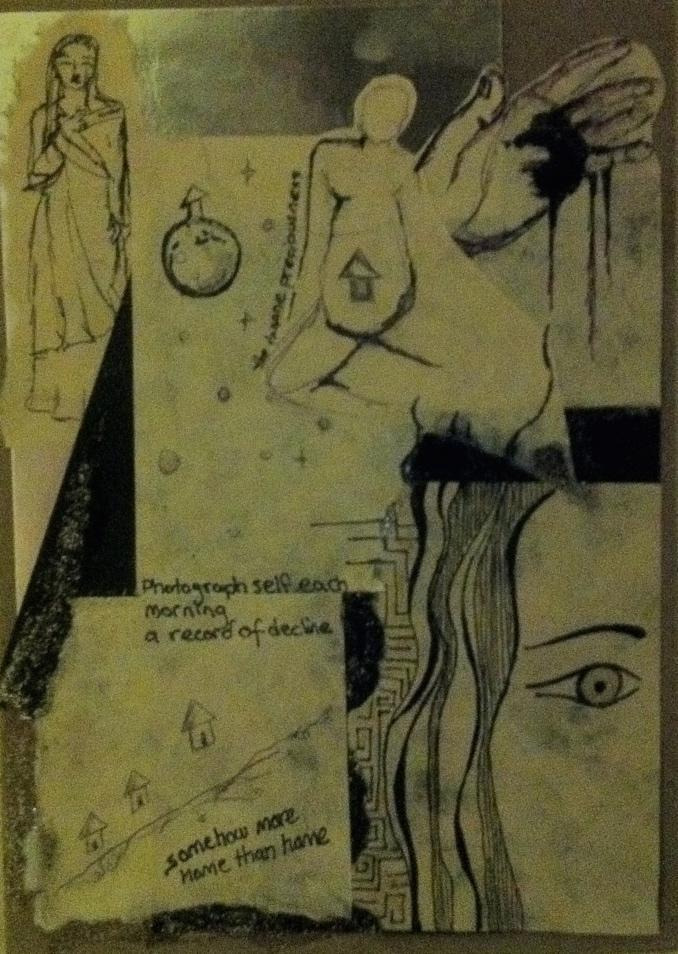
The Mother still dreams of losing this dream home (a real possibility during lengthy divorce proceedings). She even dreams of accidentally buying the wrong house and living in deep regret and longing for the home she now has. Some dreamed-up houses are fractured or crumbling, oddly missing crucial parts in her dreams.
The Mother always holds onto a lingering underlying ambivalence toward homes and houses – housewife, home life, home-making, homebodies, home base. Sometimes she goes out shopping all weekend with the daughter and buys deeply discounted decoration after decoration and adorns the house richly after a holiday, like a belated attempt to mark or perfect something already passed. Other times she is insatiable in dining out, despite her culinary creativity from growing up cooking for a large family with so few food ingredients. They take one vacation during the daughter’s childhood. Afterward, the Mother and daughter huddle together, renting one horror film after another to view at home, darkly watchingandeatingandsleeping through a week’s time before they slowly return to work and to school as if awakening from a strange, shared shadowy dream.
And because the Mother is fiercely protective of her home and occupants, she buys a series of large guard dogs as pets. This succession of dogs, all females, she believes will defend the daughters against unseen dangers. But the daughter doesn’t think much of these guardians, big enough she can ride them like ponies as a toddler. She still fears and has nightmares of the rooms in which her Mother was most hurt, bathrooms which tend to feel menacing (maybe all bathrooms are laden with the threat of an unstoppable flood of dark waters from beneath the earth).
But the Mother also remembers taking her daughter home at one time to her own parents. In that house, she says, her father carried his granddaughter precariously on the stairs. Whether the father was drunk or just generally dangerous, the Mother tells and retells the tale as a defense against her daughter wanting to return or even to know too much of her origins past her Mother. The daughter cannot actually remember the story from her own experience, which feels like another nightmare echoing. She imagines and reimagines the grandparent’s dingy home, the dark staircase, and the huge figure descending endlessly with her slipping from his arms.
The Mother also tells the daughter of nightmares of leaving her in the car alone as a toddler. At these times, the Mother awakens in a panic, grasping the daughter’s sleeping body to reassure herself of solidity in the present. The daughter does not feel she herself will slip into shadow, but does carry the same fear of slippage for her younger sister, for her smallest students, and later for her own young daughter. She wonders: how much is this legacy of anxiety a part of some intergenerational traumatic energy, and how much is merely something more of motherhood itself?
And after the daughter gives birth to her own daughter and spends a few weeks back at her Mother’s house, the daughter dreams of moving back to her childhood home. But in the daughter’s dream, the lower floor – with its comforting living room and warm kitchen – miraculously grows a small warm library in place of its fancy dining room. The daughter and granddaughter are so joyous in this verdant dream, like they have found an oasis amidst the sometimes-crushing dry loneliness of urban parenting. But they must awaken and go home numbly to the city with a strange homesickness. They cannot ever fully or properly return to the idealized warmth (womb?) of the Great Mother. The daughter reminds herself though that they were all home together once: when daughter was a fetus in the Mother’s belly, the egg that would make her baby daughter was already safe inside of her as well, like they were Russian nesting dolls together.
The house dreams are perhaps like Jung’s multi-leveled home dream, in that the first floor, the Mother’s floor, is remembered and imagined but is not really for the daughter. The daughter does not (cannot) find her own floor above, nor access the darker depths beneath of her grandparents’ ghostly realm. She sometimes feels stuck with her Mother’s dream. The generations can be like pitch black voids and rotting floors (or even like trapdoors).
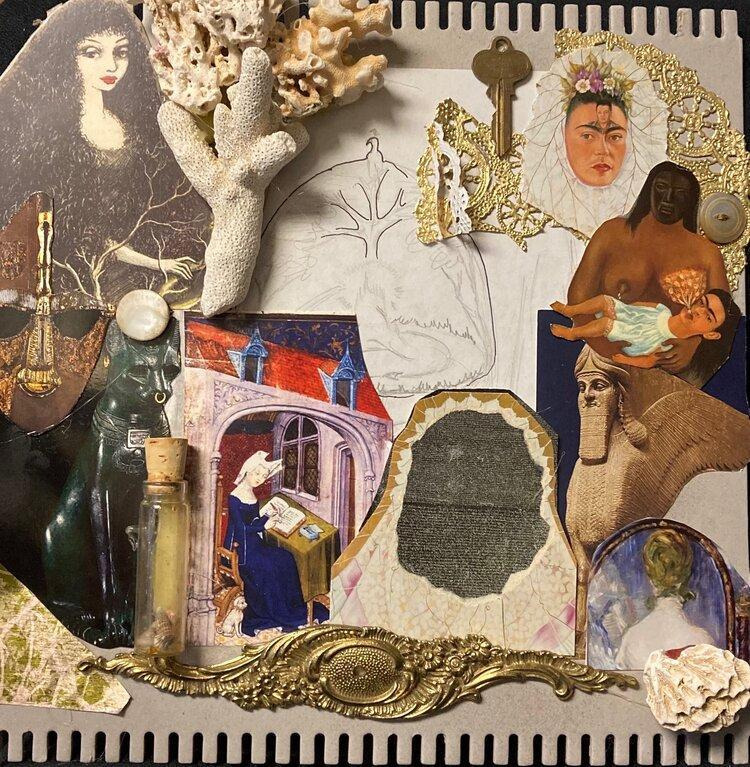
The childhood house also makes the daughter think of symbols (symbolon) themselves, as if the different parts of a home are like precious shards of a mosaic held by herself, her Mother, and her daughter. Not resembling her own Mother or sisters, the daughter looks for photographs of herself at her daughter’s age, feeling around for missing pieces and connections. Most images of her as a child are lost in the Mother’s house, consumed by a basement flood, like a small and God-like annihilation phobia realized if only briefly. Her Mother assures her from her own memory that the past daughter was once a mirror of the granddaughter (and that no lockets nor yellowed photo albums are needed for evidence). The Mother perhaps cannot understand the daughter’s longings for record and remembering. The Mother had changed her maiden name in marriage, and later changed even her first and middle name (which had once been the same as her Mother’s first and sister’s first names, and namesakes of earlier women her daughter will discover in feverish genealogical quests).
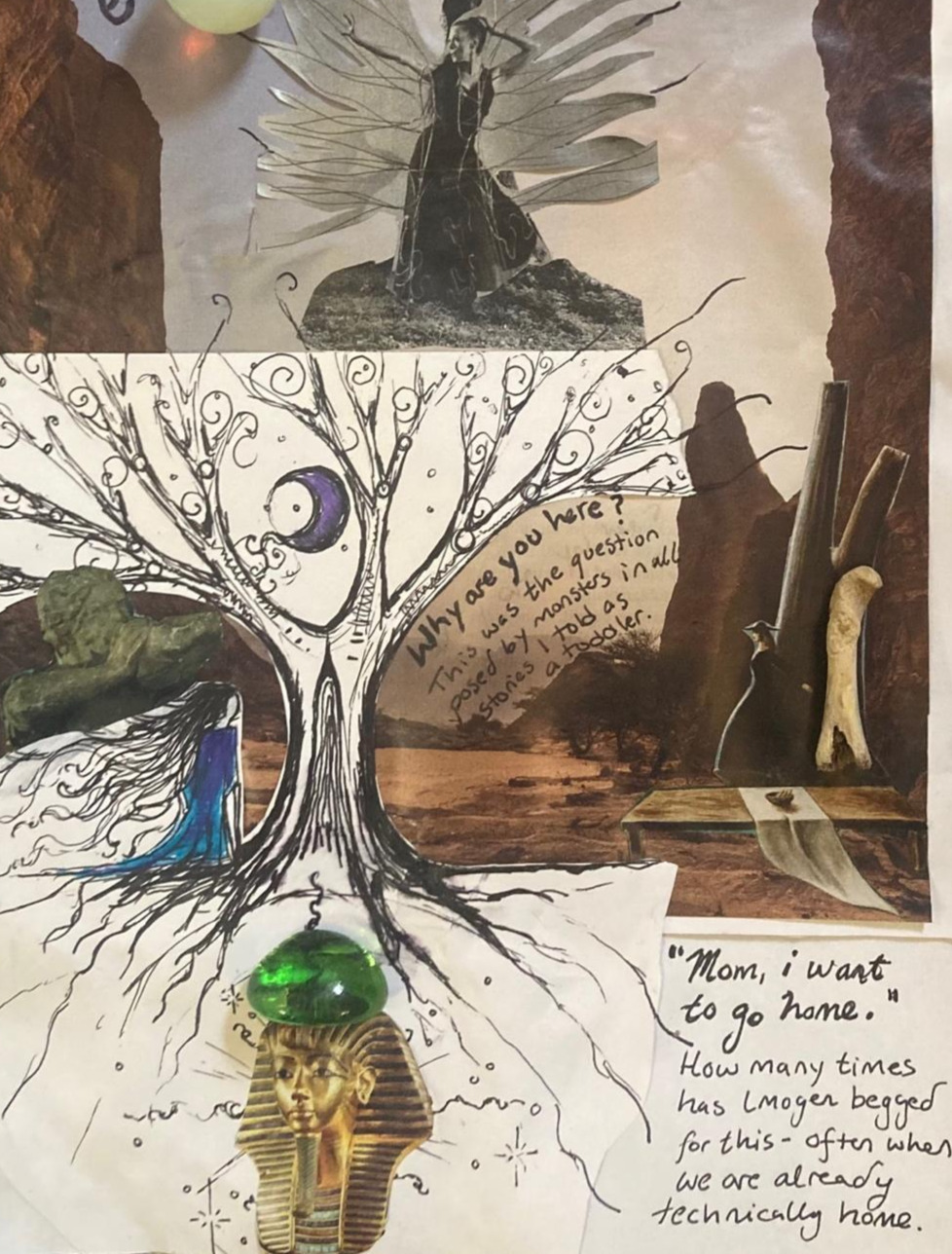
And now the granddaughter, named with the Mother’s new chosen namesake, sometimes speaks with anguish during the long days at home during the pandemic, asserting: I want to go home, I want to go home. The daughter wonders, sometimes also aloud, but what does that mean? And so the daughter looks outside in the dead of night on the border of the city and the suburbs: on the threshold of past and future. She weighs home as a symbol of freedom and solidity, with its communal and personal chambers and legacies. Home is her lingering fiction, fantasy, fascination, and fear.
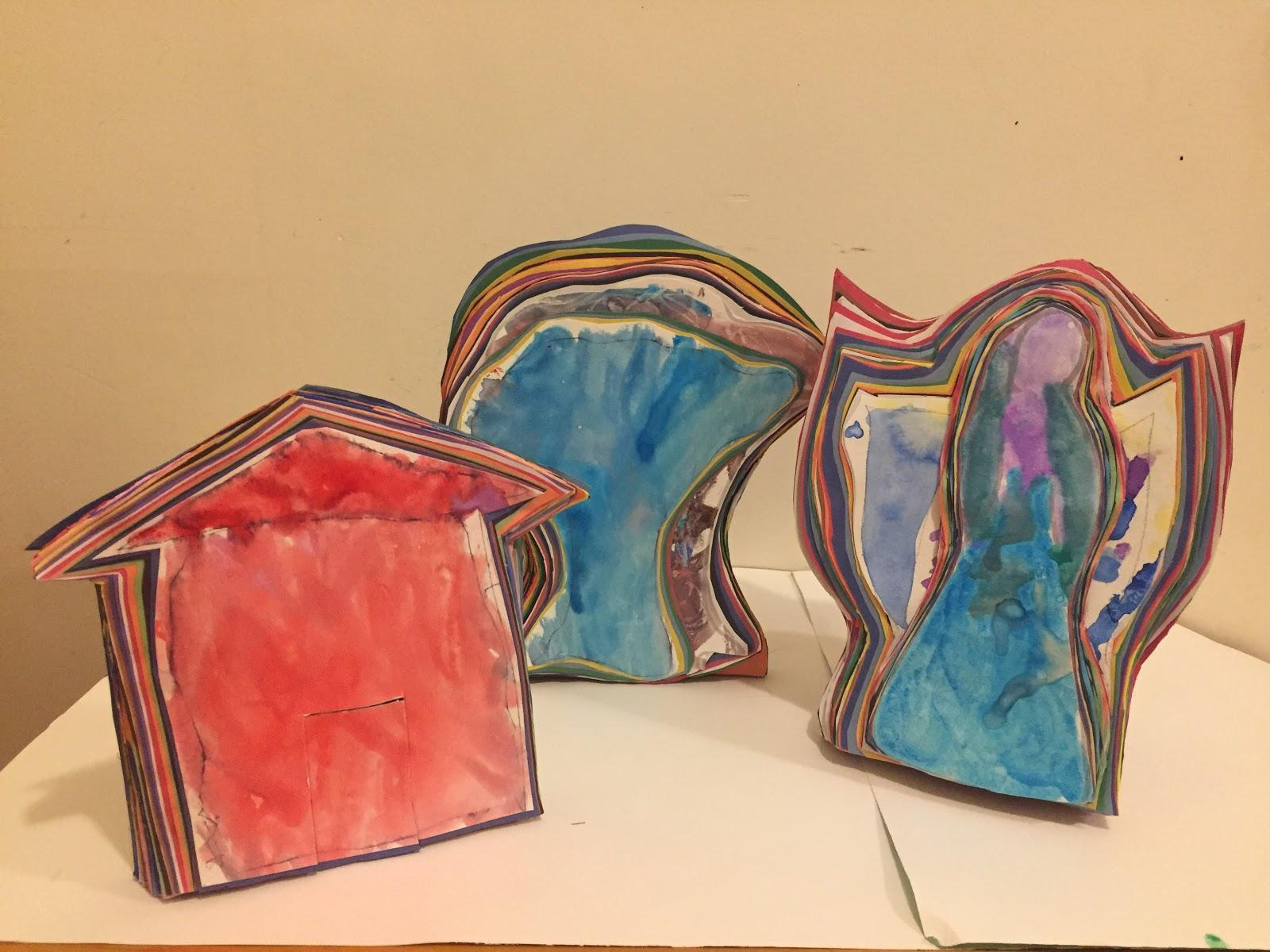
II. The Mother was once a painter; the daughter at times a sculptor.
The young granddaughter intuitively draws countless houses, trees, and people.
The daughter adds washes of paint and glues the layers of drawings together to make the slender symbols solid and strong.
The sturdy house stands on its own,
The tree will not fall,
And the person – the Mother or perhaps the daughter – can always fly away.
III. Finally, one day, the daughter dreams of her Mother’s home again.
She is drifting around like a spirit and searching everywhere for her daughter.
She ascends the second floor of the house with a sense of urgency and finds her daughter.
The windows and then the entire back wall of the house smash, break away and suddenly it is the whole ocean rising up before them.
Here is a cold and a grey landscape, but it is all so heart-stoppingly beautiful.